

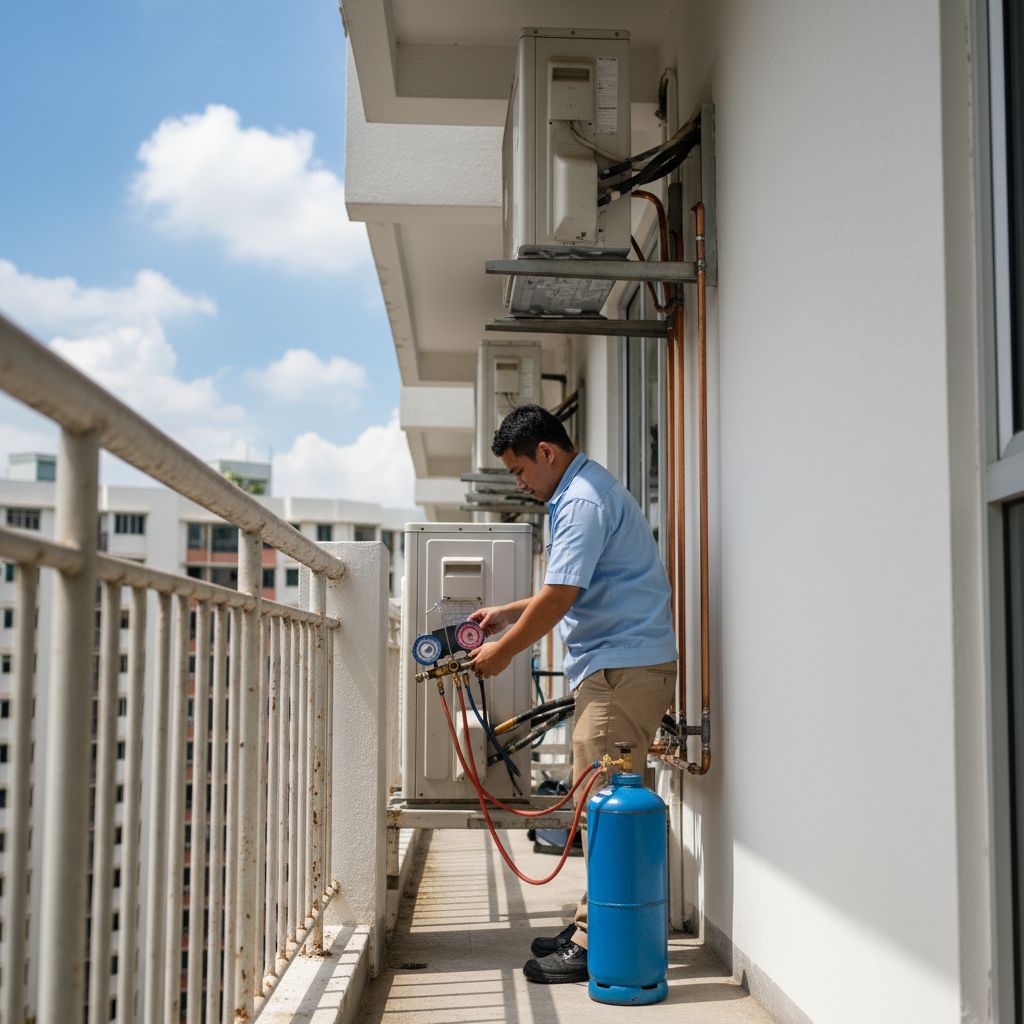
The Truth About Aircon Gas Top Up Singapore: Why Refrigerant Should Never Deplete
Every homeowner in Singapore relies heavily on their split-unit or multi-split air conditioning systems to combat the unrelenting equatorial heat and high ambient humidity. When a cooling unit suddenly begins blowing lukewarm air during a sweltering afternoon in Jurong, Tampines, or Punggol, the first instinct of many residents is to request an immediate aircon gas top up Singapore service. However, there is a fundamental misconception in the residential market regarding how refrigerant operates inside a split system. An air conditioner does not consume, burn, or deplete its refrigerant charge during normal operation the way an automobile consumes petrol or a kitchen stove consumes liquefied petroleum gas.
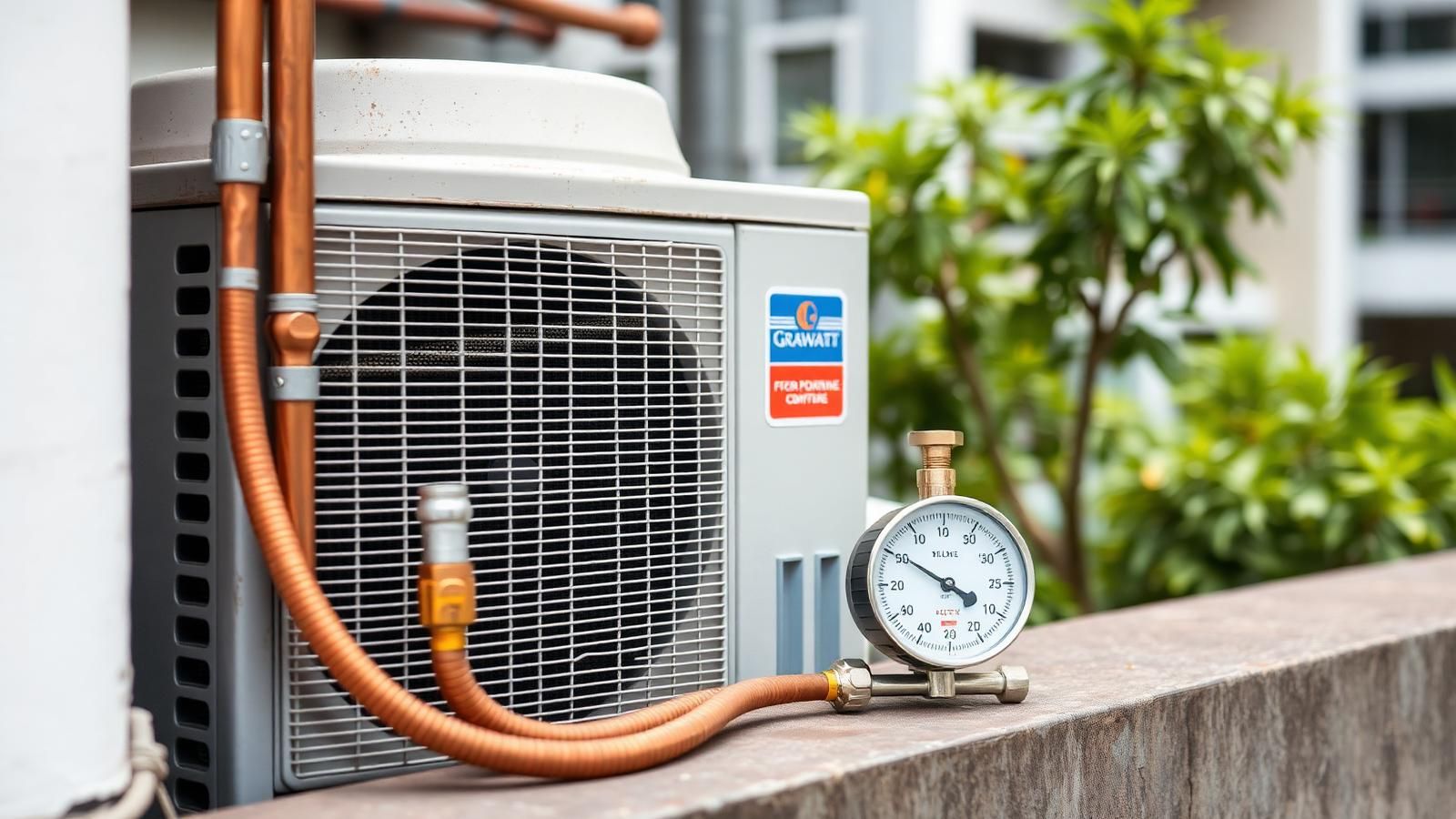
Refrigerant travels within a strictly hermetic, closed-loop thermodynamic circuit consisting of copper tubing, an indoor evaporator coil, a rotary or scroll compressor, an expansion device, and an outdoor condenser coil. Under ideal conditions, the exact volume of gas charged into the system during initial professional aircon installation remains trapped inside that sealed loop for the entire operational lifespan of the equipment. Therefore, if you are experiencing a low refrigerant aircon scenario where cooling capacity has dropped significantly, your system has suffered an integrity breach. The gas has physically escaped through a pinhole, a cracked flare joint, a rusted valve, or an imperfect brazed connection.
Understanding the distinction between a routine maintenance requirement and a mechanical failure is vital for every property owner. While an aircon gas refill can instantly restore cooling performance by replenishing lost operating pressure, simply pumping new gas into a leaking circuit without diagnosing the root cause is merely a temporary band-aid. Within weeks or months, the newly injected refrigerant will seep out through the exact same microscopic exit point, leaving you with an aircon not cold once again and an inflated utility bill from SP Group. A proper diagnostic approach evaluates whether a simple top-up is economically justifiable or if targeted aircon repair and leak isolation are mandatory.
The Closed-Loop Thermodynamic Refrigeration Cycle
To comprehend why refrigerant loss signifies a mechanical defect, one must analyze the four primary stages of the vapour-compression refrigeration cycle utilized in modern residential air conditioners across Singapore:
- Compression: The outdoor compressor pulls in low-pressure, low-temperature refrigerant gas from the indoor unit and compresses it into a high-pressure, high-temperature superheated vapour. This mechanical work increases the boiling point of the fluid.
- Condensation: The superheated vapour flows into the outdoor condenser coil. The condenser fan forces outdoor ambient air across the aluminum fins, shedding latent heat into the surrounding environment. As the refrigerant cools, it condenses into a high-pressure subcooled liquid.
- Expansion: The high-pressure liquid passes through an expansion valve or capillary tube. This constriction produces an instantaneous drop in fluid pressure, which dramatically lowers the refrigerant boiling temperature, converting a portion of it into a low-temperature liquid-vapour mixture.
- Evaporation: The cold fluid enters the indoor fan coil unit (FCU) evaporator. As warm, humid room air is drawn over the coil by the blower wheel, the refrigerant absorbs thermal energy and boils completely into a low-pressure gas. In doing so, it chills the air and condenses room moisture onto the coil drainage tray before traveling back to the compressor to repeat the cycle indefinitely.
Because the internal pathway is fully brazed and flared to withstand continuous internal pressures ranging between 100 PSI and 450 PSI, the volume of working fluid cannot diminish unless the physical containment boundary is compromised. When a technician identifies a drop in running pressure during a visit, it indicates that ambient air pressure has compromised the equilibrium through an active mechanical leak.
When an Aircon Gas Refill is a Legitimate Solution vs a Temporary Band-Aid
While fixing leaks is technically the permanent remedy, there are specific scenarios where an immediate aircon gas refill serves as a pragmatic, cost-effective choice for a homeowner. In older HDB flats scheduled for Selective En bloc Redevelopment Scheme (SERS) or properties where the owners intend to undertake major renovations within six to twelve months, paying for invasive wall hacking to access concealed copper piping within concrete beams may not make financial sense. In such cases, an economical top-up provides immediate thermal comfort until full equipment replacement takes place.
Conversely, relying on quarterly gas top-ups as a substitute for proper maintenance is counterproductive. When an air conditioner runs with insufficient refrigerant, the compressor motor lacks adequate suction cooling and operates at excessively high discharge temperatures. This thermal stress breaks down the internal polyolester (POE) or mineral lubricant oil, leading to acid formation, mechanical friction, and eventual catastrophic compressor burnout. If your system requires frequent gas additions, booking a comprehensive regular aircon servicing or an on-site mechanical inspection is essential to protect the major components.
---Common Symptoms of Low Refrigerant Aircon in Singapore Homes
Refrigerant leaks rarely announce themselves with dramatic explosions or loud hissing noises. In the majority of Singapore residential environments, leaks develop as microscopic breaches that release tiny amounts of chemical vapour over weeks or months. Recognizing the subtle warning signs of a low refrigerant aircon allows homeowners to take corrective action before secondary components, such as the compressor windings or fan motors, suffer permanent electrical damage.
Aircon Not Cold: Blowing Lukewarm Room-Temperature Breeze
The most unmistakable symptom of gas depletion is when the indoor blower operates normally, the louvers oscillate, but the air exiting the discharge grille feels like a standard mechanical fan rather than refrigerated air. In Singapore, a properly functioning inverter split system should maintain a temperature split (delta T) of approximately 8 to 12 degrees Celsius between the return air entering the top of the FCU and the supply air exiting the bottom louvers. When refrigerant drops below design parameters, the evaporator coil cannot absorb sufficient thermal energy, causing the supply air to hover near ambient room temperature (28 to 31 degrees Celsius).
Ice Formation and Frost Accumulation on Copper Pipes and Evaporator Coils
It seems paradoxical that a lack of cooling chemical would cause ice to form, but frost accumulation is a classic hallmark of low refrigerant. When the volume of gas drops within the sealed circuit, the operating suction pressure inside the indoor evaporator coil falls below normal operating thresholds. According to basic thermodynamic pressure-temperature relationships, lower suction pressure causes the refrigerant boiling point to plummet below the freezing point of water (0 degrees Celsius).
As the warm, moisture-laden tropical air of Singapore passes over these sub-zero aluminum fins, the atmospheric water vapour instantly freezes into a layer of frost rather than draining away as liquid condensate. This frost acts as an insulating blanket, choking off airflow through the coil. Over several hours of continuous operation, this ice layer thickens, traveling down the external copper suction line connecting the indoor unit to the outdoor condenser ledge. When the unit eventually cycles off, this massive block of ice melts rapidly, overwhelming the internal drainage tray and causing severe water dripping down your interior bedroom walls.
Expert Tip: If you observe white frost on the brass service valves of your outdoor compressor unit or behind the plastic filter mesh of your indoor unit, switch off the air conditioner immediately. Continuing to operate a frozen unit risks liquid refrigerant slugging into the compressor cylinder, destroying the mechanical valves.
Hissing, Bubbling, or Gurgling Sounds Inside Trunking
Under balanced running conditions, refrigerant circulates through the insulated copper lines silently or with a faint, uniform whooshing sound. When a puncture, loose flare, or cracked solder point occurs, the high-pressure gas escaping into the atmospheric air often produces a distinct hissing or whistling noise. Additionally, if the fluid level drops to a point where a mixture of liquid and vapour bubbles passes through the expansion valve unevenly, occupants may hear erratic gurgling or bubbling noises resonating through the PVC trunking along the bedroom corridor.
Surging Electricity Bills on SP Group Utility Statements
In Singapore, air conditioning represents between 40% and 60% of an average household monthly electricity expenditure. Inverter air conditioners are engineered to modulate compressor speed, ramping down to minimal power consumption once the room reaches the set target temperature (e.g., 24 degrees Celsius). When the system suffers from low gas charge, it can never satisfy the internal room thermostat. Consequently, the inverter control board drives the compressor at maximum frequency (100% load) non-stop in a futile attempt to reach the setpoint.
This continuous high-amperage draw reflects directly on your monthly SP Group utility bill. Homeowners frequently notice an unexplained spike of $50 to $120 on their electrical statements, even though their daily usage habits have remained unchanged. Restoring optimal gas balance and performing a Gentle Steam Wash to eliminate coil resistance restores thermal efficiency, instantly reducing continuous current draw.
---Refrigerant Types in Singapore: R22 vs R410A vs R32 Compared
The cooling industry has undergone substantial technological transitions driven by international environmental treaties such as the Montreal Protocol and the Kigali Amendment, both strictly enforced in Singapore by the National Environment Agency (NEA). Depending on the age of your property and the generation of your cooling equipment, your air conditioner operates on one of three primary chemical refrigerants: R22, R410A, or R32. Understanding which gas your system requires is crucial, as these chemicals exhibit drastically different operating pressures, oil compatibilities, and environmental profiles.
R22 Refrigerant (Hydrochlorofluorocarbon - HCFC)
R22, historically known by the brand name Freon, was the undisputed industry standard for residential air conditioning in Singapore throughout the 1980s, 1990s, and early 2000s. It operates at relatively moderate suction pressures (typically 60 to 75 PSI on a tropical day) and utilizes standard mineral oil for compressor lubrication. However, R22 contains chlorine molecules that actively deplete the stratospheric ozone layer when released into the atmosphere, alongside a high Global Warming Potential (GWP) of 1,810.
Under NEA regulations aligned with international phase-out schedules, the importation of virgin R22 gas and R22-based air conditioning equipment into Singapore has been strictly restricted. While it remains legal to service and top up existing R22 systems using reclaimed or existing stockpiled gas, the market supply of this refrigerant has dwindled significantly. Consequently, the cost of sourcing R22 has escalated, prompting many owners of aging flats in mature estates like Ang Mo Kio, Bedok, and Toa Payoh to replace their units or opt for a full chemical overhaul to extend equipment life without recurring gas purchases.
R410A Refrigerant (Hydrofluorocarbon - HFC Blend)
Introduced to replace R22, R410A is a near-azeotropic binary blend composed of 50% difluoromethane (R32) and 50% pentafluoroethane (R125). It possesses zero Ozone Depletion Potential (ODP), making it environmentally superior to R22 regarding ozone layer preservation. R410A quickly became the dominant cooling medium in Singapore BTO developments and private condominiums built between 2008 and 2020.
However, R410A operates at pressures nearly 50% to 60% higher than R22 (normal suction pressures range from 115 to 140 PSI, with discharge pressures exceeding 380 to 420 PSI). Because of these intense internal forces, copper piping wall thickness must meet strict gauge standards (such as Class 22 or Class 23 copper tubes) to avoid structural rupture. Furthermore, R410A relies exclusively on synthetic polyolester (POE) oil. POE oil is highly hygroscopic, meaning it aggressively absorbs ambient moisture from the air within seconds of exposure, demanding absolute vacuum perfection during any aircon repair or refilling process.
R32 Refrigerant (Hydrofluorocarbon - Next-Gen Single Component)
R32 represents the latest evolutionary leap in residential cooling technology, championed by leading Japanese and global manufacturers including Daikin, Mitsubishi Electric, and Panasonic. Unlike R410A, R32 is an unblended, single-component fluid with a GWP of only 675, representing an approximate 67% reduction in greenhouse impact compared to its predecessor. Because it is a single-molecule chemical rather than a blend, R32 can be topped up repeatedly in the field without risk of fractionation (unequal leakage of blended components).
R32 offers superior thermodynamic heat transfer efficiency, enabling modern air conditioning units to achieve higher Energy Efficiency Ratings (ticks under Singapore NEA Mandatory Energy Labelling Scheme) while utilizing up to 20% to 30% less refrigerant volume by weight. Although classified as mildly flammable (ASHRAE safety class A2L), the concentration required for ignition is exceptionally high and virtually impossible to achieve in well-ventilated residential installations.
| Refrigerant Feature / Parameter | R22 (Freon) | R410A (Puron Blend) | R32 (Pure Fluid) |
|---|---|---|---|
| Chemical Classification | HCFC (Single Component) | HFC (50/50 Zeotropic Blend) | HFC (Single Component) |
| Ozone Depletion Potential (ODP) | 0.055 (Ozone Damaging) | 0.000 (Zero ODP) | 0.000 (Zero ODP) |
| Global Warming Potential (GWP) | 1,810 | 2,088 | 675 |
| Typical Suction Pressure (Singapore) | 65 to 75 PSI | 120 to 135 PSI | 115 to 130 PSI |
| Compressor Lubricating Oil | Mineral Oil (Non-hygroscopic) | Synthetic POE Oil (Hygroscopic) | Synthetic POE / PVE Oil |
| Singapore Regulatory Status | Phased out; restricted imports | Widely used; transitioning out | Current industry standard |
| Fractionation Risk on Leakage | None (Can be topped up) | Moderate (Blend may separate) | None (Can be topped up directly) |
Why You Must Never Mix Different Refrigerants
Under no circumstances should different types of refrigerants be mixed within the same compressor circuit. Introducing R410A into an older R22 system will result in instant over-pressurization, bursting copper lines or blowing the compressor head gasket. Conversely, charging R22 into an R410A system contaminates the synthetic POE oil with incompatible mineral compounds, creating thick chemical sludge that permanently clogs the capillary tube and destroys the internal motor bearings.
---Root Causes of Refrigerant Leaks in HDBs, Condominiums, and Landed Properties
Singapore tropical climate poses unique environmental challenges that accelerate the physical degradation of air conditioning mechanical connections. High ambient humidity, combined with airborne salt particles along coastal districts like Marine Parade, Pasir Ris, and East Coast, accelerates oxidation. Understanding the common failure points helps identify the most appropriate repair intervention.
1. Flare Joint Degradation and Loose Brass Flare Nuts
In standard ductless split installations across Singapore HDBs and condos, indoor fan coils are connected to copper lines via mechanical flare joints rather than welded connections. A flare joint relies on a conical copper lip compressed firmly against a brass union fitting by a threaded flare nut. Over time, the continuous thermal expansion and contraction cycles of the unit, combined with microscopic motor vibrations, cause the brass nut to loosen slightly. Furthermore, if an inexperienced installer overtightens the brass nut during initial setup, the copper flare lip can develop microscopic stress fractures that slowly weep gas over several years.
2. Formicary Corrosion and Copper Pitting
Formicary corrosion, often called "ant-nest corrosion," is an insidious chemical phenomenon that accounts for thousands of unexplainable leaks in modern residential air conditioning evaporator coils. This chemical reaction occurs when moisture, oxygen, and trace organic acids (such as formic or acetic acids) combine on the surface of thin-walled copper tubes. These organic acids are emitted naturally by common household items, including MDF furniture, paints, vinyl flooring, cleaning detergents, and household cosmetics.
In tightly sealed, air-conditioned Singapore apartments with minimal outdoor ventilation, these acid vapours dissolve into the condensed water running down the indoor evaporator fins. The resulting acidic solution etches microscopic, winding tunnels through the copper tube wall. Eventually, these sub-micron tunnels penetrate the entire tube thickness, releasing high-pressure refrigerant. Formicary corrosion cannot be repaired by standard brazing because the entire copper structure becomes porous; the affected coil must be replaced or subjected to a thorough chemical wash treatment to remove surface corrosive agents before minor breaches expand.
3. Poor Installation Workmanship and Substandard Bending
Workmanship quality plays a massive role in piping longevity. During renovation installations, copper tubes must be routed through concrete partitions, ceiling falseworks, and exterior trunking. If technicians bend the lines without using external bending springs or specialized hydraulic bending tools, the copper tube can kink internally. A kinked pipe creates an artificial restriction, generating extreme localized pressure waves and turbulence that eventually erode the copper wall from the inside out, leading to premature gas leakage.
4. Environmental Salt Air and Acidic Sewage Gas Exposure
In landed properties and low-floor HDB flats located near open monsoon drains, drainage canals, or sewage inspection chambers, airborne hydrogen sulfide ($H_2S$) gas poses a severe threat. Hydrogen sulfide reacts aggressively with copper, forming brittle copper sulfide ($Cu_2S$) flakes. This corrosive attack rapidly eats away at the outdoor condenser U-bends and service valves, necessitating periodic inspections and defensive maintenance.
---Professional Refrigerant Leak Detection and Diagnostic Procedures
Locating a micro-leak within several dozen meters of insulated copper trunking running through multiple rooms requires scientific methodology and specialized diagnostic tools. Professional technicians employ systematic testing protocols rather than guessing where the breach exists.
Visual and Bubble Solution Testing (Soapy Water Method)
The most immediate and traditional test involves applying a calibrated surfactant bubble solution over accessible mechanical joints, including the outdoor service valve ports, flare connections behind the indoor unit backplate, and visible brazed joints. If a leak is active, the escaping gas produces continuous, expanding bubbles within seconds. While effective for moderate to large leaks, this method cannot detect micro-leaks buried deep inside wall-mounted trunking or within the dense aluminum fins of the condenser coil.
Electronic Halogen Sniffers (Heated Diode & Infrared Sensors)
To detect leaks losing as little as 3 grams of gas per year, technicians utilize handheld electronic halogen leak detectors. These devices draw air samples through a flexible gooseneck probe across a heated diode or infrared sensor cell. When halogenated chemical molecules (such as fluorine or chlorine present in R22, R410A, and R32) enter the sensor chamber, the electrical resistance changes instantly, triggering an audible alarm and digital concentration readout. This tool allows technicians to trace closed trunking runs and pin-coil locations without dismantling the entire casing.
High-Pressure Standing Nitrogen Decay Testing
When electronic sniffers fail to isolate a microscopic leak concealed behind a false ceiling or structural wall, the definitive diagnostic standard is a high-pressure nitrogen standing test. The technician recovers any remaining refrigerant into a recovery cylinder, connects a dry nitrogen regulator, and pressurizes the isolated copper circuit up to 400 to 500 PSI. Nitrogen is an inert, dry gas with very small molecular dimensions, making it ideal for testing structural integrity.
The system is left under pressure for a defined observation period (typically 24 to 48 hours) with digital test gauges attached. If the digital pressure reading drops by even a fraction of a PSI (after compensating for ambient temperature fluctuations), a breach is conclusively proven to exist within that isolated piping segment. At Uncle 7 Aircon, our transparent $40 on-site diagnostic inspection fee covers comprehensive electrical and pressure diagnostics to provide you with an honest appraisal of necessary repairs before any work begins.
---Step-by-Step Process for a Proper Aircon Gas Refill and Leak Repair
Executing an aircon gas top up Singapore correctly is a precise thermodynamic procedure requiring precision tools, manifold gauges, vacuum pumps, and digital scales. Adding gas haphazardly without checking subcooling or superheat values risks destroying the system. Below is the exact step-by-step procedure followed by seasoned trade professionals.
- System Isolation and Leak Remediation: Before any gas is added, the physical breach must be repaired. If a flare nut is cracked, the technician cuts away the damaged copper end using an orbital tube cutter, deburrs the internal edge, slides on a heavy-duty forged brass flare nut, and forms a brand-new 45-degree flare using an eccentric cone flaring tool. If the leak is located on a copper U-bend, the area is sanded clean and brazed using a 5% to 15% silver-bearing brazing alloy under an inert nitrogen purge to prevent internal oxidation.
- Deep System Evacuation (Pulling a Vacuum): Once the mechanical repair is complete, the manifold gauge set and a two-stage rotary vane vacuum pump are connected to the service ports. The pump is engaged to evacuate all atmospheric air, non-condensable gases, and ambient moisture from the lines. The vacuum must pull down below 500 microns ($0.5\text{ mmHg}$) and hold steadily for a minimum of 15 minutes. This step is critical because atmospheric moisture reacts with POE compressor oil to create hydrofluoric acid, which dissolves internal motor enamel.
- Refrigerant Charging by Liquid Weight: For empty or heavily depleted systems, charging by weight using a calibrated digital charging scale is the only manufacturer-approved method. The refrigerant canister is inverted (for liquid charging of R410A blends) on the digital scale, zeroed out, and the exact factory charge specified on the outdoor condenser data plate (e.g., 0.95 kg for a standard multi-split outdoor unit) is metered into the liquid line.
- Operational Performance and Delta T Verification: After the initial charge is introduced, the unit is powered on and run at maximum cooling capacity for 15 to 20 minutes to allow pressures to stabilize. The technician monitors suction pressure, checks compressor running current (amperage) using a clamp meter against the electrical rating plate, and measures the delta T temperature drop across the indoor evaporator coil. If readings align with factory specifications, the service valves are torqued down, valve caps sealed, and testing is complete.
Aircon Gas Top Up Pricing and Service Options in Singapore
Understanding the pricing landscape for air conditioning servicing helps homeowners make informed decisions and avoid deceptive sales tactics. In the Singapore market, some unscrupulous operators advertise unsustainably cheap general servicing fees only to aggressively claim that your gas is dangerously empty, demanding hundreds of dollars for unnecessary top-ups.
Uncle 7 Aircon operates on a strictly transparent, straightforward business philosophy. We believe in upfront, honest rates with zero hidden charges, zero high-pressure sales pitches, and no complicated multi-year contracts. All our servicing appointments are one-time engagements tailored to your immediate needs, available every day starting from 9am across all residential and small commercial properties in Singapore.
When you schedule a full chemical overhaul ($100 per unit flat rate), any necessary refrigerant top-up is completely included at no additional cost. This provides unmatched value, as the entire fan coil unit is completely dismantled down to the bare chassis, thoroughly degreased, chemically soaked to remove deep-seated fungal slime, pressure-rinsed, reassembled, and recharged to optimal operating performance.
| Service Package | Pricing Structure | Estimated Duration | Scope & Inclusions |
|---|---|---|---|
| General Servicing | 1 unit: $40 2 units: $100 3-9 units: $18 / unit 10+ units: $10 / unit |
~15 minutes per unit | Filter cleaning, front panel wash, evaporator surface vacuum, blower wheel dust removal, drainage pipe flush, running test. |
| Chemical Wash | 1 unit: $60 2 units: $80 3 units: $90 4+ units: $28 / unit |
~30 minutes per unit | On-wall chemical application, deep coil flushing to eliminate stubborn jelly sludge, blower fan wash, deodorizing treatment. |
| Chemical Overhaul | Flat $100 per unit | ~60 minutes per unit | Complete physical teardown of FCU, chemical bath immersion, bearing lubrication, full drainage declogging, gas top-up included if needed. |
| Aircon Repair Diagnostic | $40 on-site inspection | ~30 to 45 minutes | Comprehensive physical and electrical fault finding, pressure gauge evaluation, clear transparent quote before work begins. |
| Gentle Steam Wash | Contact for quote | ~30 to 45 minutes | High-temperature hot vapour deep clean, sanitizes 99.9% of bacteria and mould spores without harsh chemical corrosion. |
Please note that Uncle 7 Aircon operates on a direct, transparent one-time service model. To keep our rates among the most competitive in the country, we do not offer maintenance contracts or after-hours emergency call-outs, and no warranty is provided after service completion. You pay strictly for the high-quality workmanship delivered on the day of service.
---Maintenance Strategies: How Regular Servicing Prevents Gas Leaks
Preventative care is vastly more economical than dealing with major refrigerant leaks and premature compressor replacements. By adhering to a disciplined maintenance schedule, homeowners can safeguard their cooling investments against premature breakdown.
Preventing Head Pressure Spikes via Regular Cleaning
When indoor filters, blower wheels, and outdoor condenser fins become clogged with airborne dust, pet fur, and cooking grease, the system suffers severe heat transfer impedance. In the outdoor unit, a dirt-choked condenser cannot reject heat effectively, causing the internal operating head pressure to skyrocket far beyond normal design limits. These repetitive high-pressure spikes place immense mechanical strain on flare joints, brazed copper elbows, and internal compressor discharge valves. By scheduling regular general servicing or an eco-friendly Gentle Steam Wash, you keep running pressures balanced, directly protecting your pipework from stress-induced fractures.
The Advantage of Uncle 7 Gentle Steam Wash
While traditional chemical washes use acidic or alkaline foaming solutions to dissolve dirt, repeated exposure to harsh chemicals can gradually strip away the protective blue-fin hydrophilic coating on aluminum evaporator fins, accelerating base metal oxidation. Uncle 7 Aircon offers a dedicated Gentle Steam Wash service that utilizes high-temperature, pressurized water vapour. The intense thermal energy naturally emulsifies grease, dissolves stubborn fungal mats, and neutralizes bacteria deep within the coil matrix without exposing delicate copper tubing to corrosive chemical compounds.
Inspecting Trunking Insulation and Preventing Condensation Rot
In Singapore humid climate, external copper piping must be encapsulated in high-grade closed-cell elastomeric nitrile rubber insulation (such as Armaflex). If this insulation degrades or is chewed through by rodents, the cold copper surface comes into direct contact with ambient humid air. This leads to continuous sweating (condensation) inside the trunking, which not only rots false ceilings and drywall but also creates a localized micro-climate of continuous moisture that accelerates formicary corrosion on the copper exterior. Periodic inspections ensure insulation seams remain tightly glued and airtight.
---Why Choose Uncle 7 Aircon for Your Cooling and Repair Needs
With dozens of air conditioning contractors operating across the island, finding a dependable, honest technician who respects your home and your wallet can be daunting. Uncle 7 Aircon has established a stellar reputation across Singapore by adhering to old-school trade integrity combined with transparent, no-nonsense pricing.
- Islandwide Coverage Across All Housing Types: Whether you occupy a 3-room HDB flat in Woodlands, a new BTO in Tengah, a private condominium in Bukit Timah, a multi-storey landed property in Serangoon Gardens, or a small commercial shop in Chinatown, our mobile teams cover every corner of Singapore. Learn more about our regional coverage on our service areas page.
- Expertise Across All Major Aircon Brands: Our technicians possess extensive hands-on troubleshooting experience with all major market brands, including Midea, Daikin, Mitsubishi Electric, Panasonic, Fujitsu, Hitachi, LG, and Samsung. We understand the specific diagnostic error codes, thermistor resistances, and factory operating pressures unique to each manufacturer.
- Direct, Honest Pricing: We publish our service costs transparently on our pricing guide. You never have to worry about bait-and-switch tactics, arbitrary price inflations, or surprise surcharges when our technicians arrive at your doorstep.
- No Pressure, One-Time Servicing: We do not lock our clients into rigid, costly quarterly maintenance contracts. You engage our services precisely when you need them. Whether it is a quick one-off general servicing, an intensive chemical overhaul, or focused mechanical troubleshooting, you retain complete control over your home maintenance schedule.
- Convenient Booking: Operating daily starting at 9am, booking an appointment is as simple as sending a message via WhatsApp or calling our dedicated helpline at 9431 1589. Explore our technical library on our knowledge hub and browse helpful maintenance guides in our educational articles section. For immediate assistance or direct inquiries, visit our contact page today.
Frequently Asked Questions (FAQ)
How do I know if my aircon needs a gas top up or just a chemical wash?
If your air conditioner is blowing warm air and the airflow is strong, but the copper pipes outside or the evaporator coil inside show signs of white ice frost accumulation, the system is suffering from low refrigerant and likely requires an inspection and top-up. Conversely, if the air coming out is cool but the airflow is weak, sputtering, or accompanied by a musty, foul odour and visible dark mold specks on the blower fan wheel, the cooling capacity is simply blocked by dirt. In that scenario, a thorough chemical wash or chemical overhaul is needed rather than an aircon gas refill.
How often should an aircon gas top up be done in Singapore?
Under perfect operating conditions, an air conditioner should never require a routine gas top-up. Because the refrigeration circuit is completely hermetically sealed, the original factory gas charge should last for the entire design lifespan of the equipment (typically 8 to 15 years). If your system requires gas additions every few months, there is an active mechanical leak at a flare connection, copper joint, or coil bend that must be diagnosed and repaired through proper aircon repair procedures.
Is refrigerant gas top up included in Uncle 7 Chemical Overhaul service?
Yes. When you book Uncle 7 Aircon for a full chemical overhaul at our transparent flat rate of $100 per unit, refrigerant gas top-up is completely included at no extra charge if our diagnostic manifold gauges indicate your system is running low on pressure. The chemical overhaul involves completely dismantling the fan coil unit, soaking the components in specialized cleaning solutions, clearing the drainage line, reassembling the system, and ensuring operating pressures are fully restored.
Why is R22 gas top up more expensive than R410A or R32?
R22 is an older hydrochlorofluorocarbon (HCFC) refrigerant that has been phased out globally under the Montreal Protocol and strictly restricted in Singapore by the National Environment Agency (NEA) due to its ozone-depleting properties. Because virgin R22 can no longer be freely imported into Singapore, technicians must rely on limited existing domestic stockpiles or certified reclaimed gas. This acute supply scarcity significantly drives up the raw acquisition cost of R22 compared to modern, readily available refrigerants like R410A and R32.
Can you top up an R410A air conditioner without completely replacing the gas?
In cases of minor leakage (less than 15% to 20% of total system charge), an R410A system can often be topped up directly in liquid form to restore immediate cooling. However, because R410A is a near-azeotropic 50/50 blend of R32 and R125, a severe or slow leak can cause fractionation, where one component chemical leaks out at a slightly faster rate than the other. When significant fractionation occurs, simply adding more gas will not restore optimal thermodynamic efficiency; the remaining degraded blend must be recovered, a deep vacuum pulled, and a fresh charge weighed in according to the manufacturer data plate.
What happens if I continue running an air conditioner that has low gas?
Operating an air conditioner with low refrigerant forces the compressor to work under severe thermal and mechanical stress. The compressor relies on the returning cool suction gas to dissipate the intense heat generated by its electric motor windings. When refrigerant is insufficient, the compressor overheats rapidly, causing the internal lubricating oil to break down and turn acidic. This friction will eventually seize the mechanical scroll or rotor, leading to catastrophic compressor burnout, which requires an expensive replacement.
How much does an on-site diagnostic inspection cost with Uncle 7 Aircon?
Uncle 7 Aircon charges a standard, transparent on-site diagnostic inspection fee of $40. Our experienced technician will visit your HDB, BTO, condo, or landed property, connect professional manifold gauges to evaluate system pressures, inspect electrical contactors, check thermistors, and isolate the source of any faults or leaks. We provide a clear, upfront quote for the required repair before any work begins, ensuring complete transparency with zero hidden surprises.
What is the difference between Uncle 7 Chemical Wash and Gentle Steam Wash?
Our chemical wash uses specialized cleaning solutions applied directly to the on-wall fan coil unit to dissolve stubborn biological slime, dirt buildup, and grease that regular vacuuming cannot remove. Our Gentle Steam Wash utilizes high-pressure, high-temperature hot vapour to deep-clean and sanitize the evaporator coil, blower wheel, and air pathways. The Gentle Steam Wash eradicates 99.9% of bacteria and fungal spores without the use of harsh chemicals, making it ideal for households with sensitive individuals, young infants, or those seeking an eco-friendly deep clean.
Does Uncle 7 Aircon offer warranty coverage or monthly maintenance contracts?
No. Uncle 7 Aircon operates on a direct, honest one-time servicing model designed to provide maximum flexibility and cost savings to Singapore homeowners. We do not offer maintenance contracts, locking you into recurring commitments, nor do we provide post-servicing warranties. Our business focus is delivering top-quality workmanship at highly competitive, transparent rates during every single on-site visit.
How do I book an aircon gas refill or repair service with Uncle 7 Aircon?
Booking an appointment is fast and effortless. You can message or call our team directly on WhatsApp or phone at 9431 1589. Our service hours commence at 9am daily, covering all residential estates and small commercial properties throughout Singapore. Simply let us know your location, the number of units, the brand of your air conditioner, and the symptoms you are experiencing, and we will arrange our earliest available one-time servicing slot.
RELATED ARTICLES
How Often Should You Service Your Aircon in Singapore? (2026 Frequency Guide)
Living in Singapore means relying heavily on air conditioning to stay comfortable against year-round heat and tropical humidity. With ambient temperatures frequently exceeding 32 degrees Celsius and r
Aircon Not Cold? 12 Causes and Fixes for Singapore Homes (2026 Repair Guide)
Aircon running but not cold? Here are the 12 causes Uncle 7 Aircon sees most often in Singapore HDB flats and condos, what you can check yourself, and what repair really costs.
HDB Aircon Servicing Singapore: The Complete Homeowner Guide
Everything HDB homeowners in Singapore need to know about aircon servicing: prices, chemical wash vs overhaul, leaking units, ledge condensers, mould smells and how often to service.