

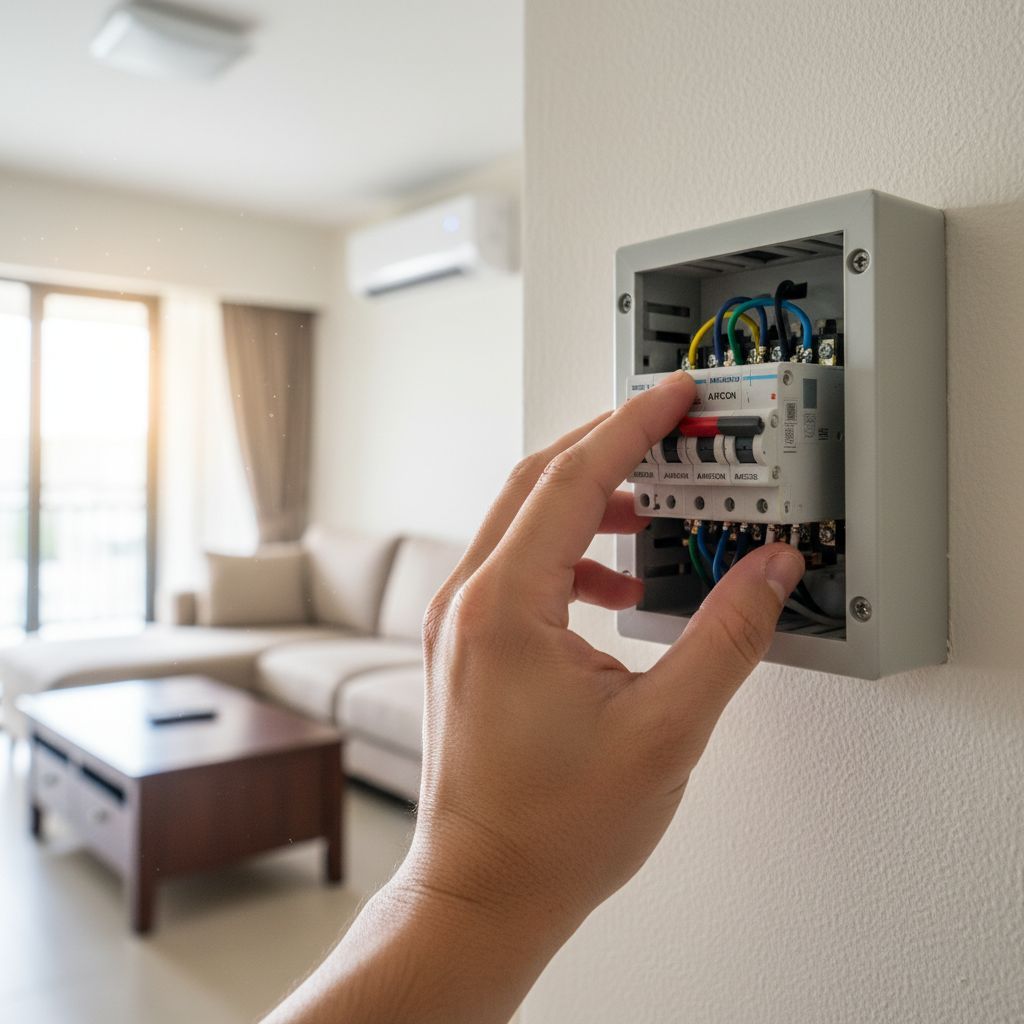
Understanding Why Your Aircon Trips the Circuit Breaker in Singapore
When you switch on your air conditioner on a hot Singapore afternoon only to hear a sudden click from your distribution box (DB box) followed by complete darkness in your room, you are experiencing an electrical trip. An aircon tripping power issue is one of the most disruptive and urgent household problems in Singapore. In our tropical climate, where temperatures routinely exceed 32 degrees Celsius and humidity levels hover above 80 percent, air conditioning systems operate under heavy thermal load for extended hours. When electrical or mechanical components degrade under this sustained stress, the safety mechanisms inside your DB box instantly cut off electricity to prevent catastrophic electrical fires, wiring meltdowns, or severe electrocution hazards.
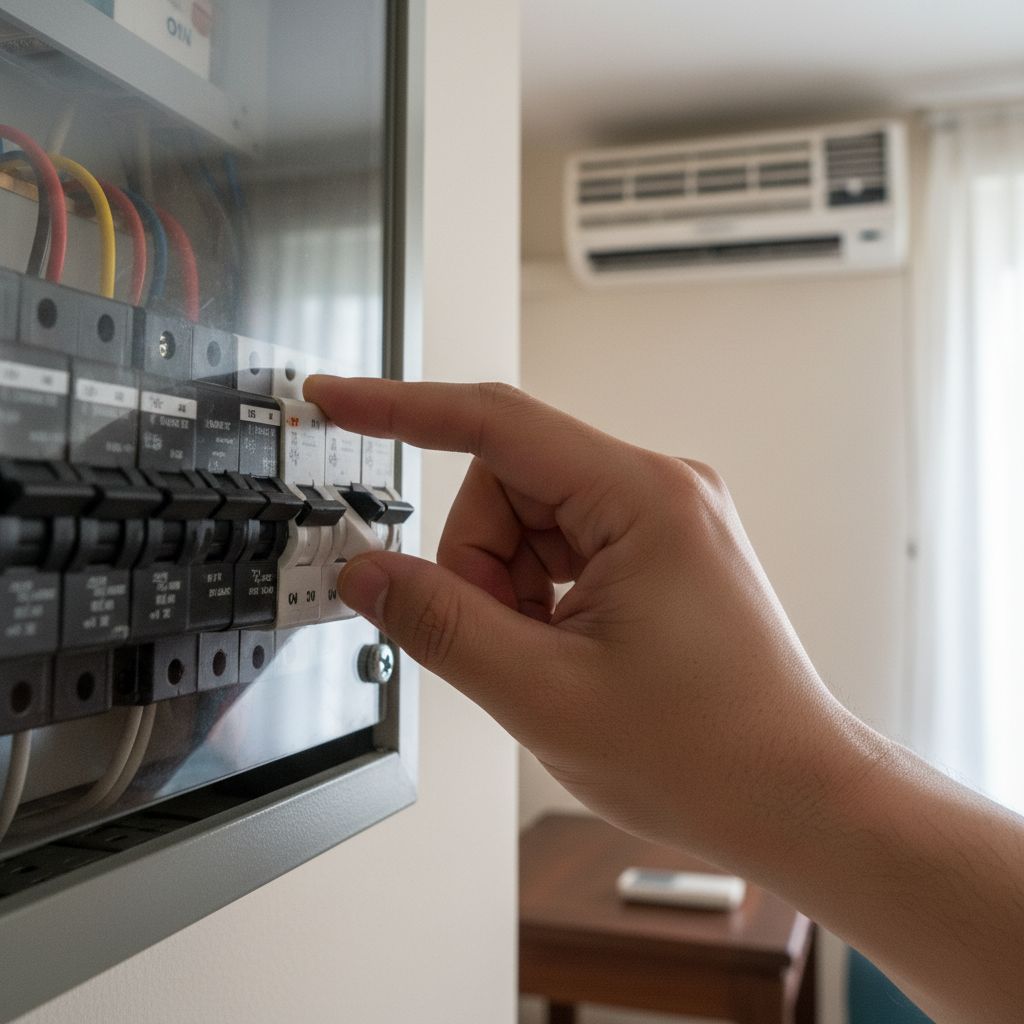
A tripping circuit breaker is not just an inconvenience, it is an active safety alert indicating that an electrical anomaly has occurred within your cooling system. Whether you reside in an HDB flat in Jurong, a newly renovated BTO estate in Punggol, a private condominium in Bukit Timah, or a landed residence in Serangoon, your electrical infrastructure relies on calibrated circuit breakers to safeguard your home. To understand why your aircon trips breaker Singapore homeowners must first understand how modern residential electrical safety devices operate, what triggers them, and why continuing to force-reset a tripped switch can create dangerous consequences for your property.
How Your DB Box and Earth Leakage Circuit Breaker (ELCB) Work
Your residential distribution board contains multiple protective switches, each designed to detect specific electrical faults. The primary safety devices protecting your air conditioning circuit are the Miniature Circuit Breaker (MCB), the Residual Current Circuit Breaker (RCCB), and the Earth Leakage Circuit Breaker (ELCB). In standard Singapore HDB and condominium installations, a dedicated 20-ampere or 30-ampere double-pole isolator switch connects your outdoor condenser unit directly to a designated MCB and RCCB in your main DB panel.
The MCB is engineered to monitor current volume. If an air conditioner suddenly pulls 40 amperes through a 20-ampere circuit due to a jammed motor or mechanical obstruction, the bimetallic strip inside the MCB heats up rapidly, triggering the switch to snap open and isolate the branch circuit. In contrast, the RCCB or ELCB continuously monitors the balance of electrical current flowing through the live and neutral conductors. Under normal operating conditions, the current entering your air conditioner via the live wire must exactly equal the current returning through the neutral wire. If as little as 30 milliamperes of current leaks out of the normal circuit path and bleeds into the earth wire or metal chassis of the condenser, the ELCB detects this imbalance within a fraction of a second and cuts total power to protect occupants from fatal electric shocks.
The Difference Between an Overload and an Aircon Short Circuit
Homeowners often confuse a standard circuit overload with a dangerous aircon short circuit. Understanding the fundamental difference between these two failure modes helps diagnose whether the issue stems from excessive electrical demand or a catastrophic component breakdown inside the unit:
- Circuit Overload: An electrical overload occurs when the aggregate power consumption of appliances connected to a single circuit exceeds the rated current-carrying capacity of the circuit breaker and wiring. For instance, if your air conditioner runs continuously with filthy filters, choked cooling coils, and a failing fan motor, the electrical components must work significantly harder to move heat. This extra strain causes the operational current to climb steadily until it trips the thermal mechanism inside the breaker after several minutes or hours of operation.
- Direct Short Circuit: An aircon short circuit occurs when a high-voltage live conductor comes into direct, unhindered contact with a neutral conductor or grounded metal frame, bypassing the normal electrical resistance of the load. This direct contact causes electrical resistance to drop toward zero, generating an instantaneous surge of hundreds of amperes of current. The magnetic trip mechanism inside your MCB responds within milliseconds, causing an explosive snapping sound at the DB box the precise moment you toggle the aircon on switch.
Both conditions demand immediate attention from an experienced technician. Ignoring either issue and repeatedly flipping the breaker switch back to the on position can quickly destroy expensive internal electronics or ignite the insulation jacket on your internal electrical wiring.
Major Mechanical and Electrical Causes of Aircon Tripping Power
Modern inverter air conditioners from renowned brands like Daikin, Mitsubishi Electric, Panasonic, Midea, Fujitsu, Hitachi, LG, and Samsung rely on sophisticated interconnections between high-voltage mechanical components and sensitive printed circuit boards. When an unexpected breakdown happens, the root cause generally originates from one of several key mechanical or electrical points of failure inside the indoor fan coil unit or the outdoor multi-split condenser.
Severe Compressor Fault and Grounded Windings
The compressor is the mechanical heart of your air conditioning system, responsible for pumping refrigerant at high pressure through the copper pipe network. A major compressor fault is the single most common and costly reason for an aircon tripping power event in Singapore. Inside the sealed compressor housing, electric motor windings are insulated by specialized enamel coatings and immersed in lubricating synthetic oil. Over years of continuous operation under intense tropical heat, this insulation can break down due to thermal degradation, acidity in contaminated refrigerant, or moisture ingress.
When the enamel insulation fails completely, the copper windings make direct physical contact with the metal casing of the compressor. This catastrophic condition, known in the trade as a grounded or shorted compressor winding, creates an immediate dead short to earth. The millisecond power is supplied to the compressor contactor, the system draws Locked Rotor Amperes (LRA), sending an enormous surge of electricity straight to ground and tripping your ELCB or main breaker instantly. In such scenarios, professional aircon repair Singapore technicians must test the compressor winding resistance with a high-voltage insulation tester (Megger) to confirm if the motor is completely burned out.
Failing Run Capacitors and Electrical Surges
In non-inverter systems and certain single-phase inverter condenser models, start and run capacitors provide the necessary electrical phase shift and voltage boost to spin the compressor and outdoor fan motors. Capacitors store substantial electrical energy and discharge it to maintain smooth motor rotation. However, Singapore's constant heat and voltage micro-surges cause capacitor electrolytes to dry up and expand over time.
When a run capacitor weakens or ruptures, its capacitance drops below the threshold required to turn the motor shaft. Deprived of the necessary rotational torque, the compressor motor stalls in a locked position. When a motor is locked, it pulls up to five to six times its nominal running current. Within 3 to 10 seconds of startup, this massive current draw triggers the thermal overload protector or causes the circuit breaker to trip from sustained overcurrent. Replacing a swollen, leaking capacitor is a routine repair, but leaving a failing capacitor unaddressed will rapidly overheat and destroy the expensive compressor motor windings.
Defective Fan Motors and Seized Bearings
Both your indoor fan coil unit (FCU) and outdoor condenser rely on precision electric fan motors to reject heat and circulate chilled air. Over time, the internal ball bearings of these motors accumulate dust, dirt, and pet dander, or dry out from prolonged heat exposure. As bearing friction increases, the motor requires significantly more electrical current to rotate the heavy fan blades.
Eventually, the motor bearings may seize entirely, preventing the fan rotor from turning. Just like a stalled compressor, a seized indoor blower motor or outdoor fan motor will draw excessive electrical current, causing the motor internal thermal fuse to blow or tripping the MCB. Furthermore, if the internal motor windings suffer an electrical short circuit due to vibration or age, the resulting short will trip the circuit breaker the moment the fan is engaged by the control board.
Moisture Ingress and Printed Circuit Board (PCB) Short Circuits
Contemporary inverter air conditioners utilize complex printed circuit boards (PCBs) located inside both the indoor and outdoor units. The outdoor inverter PCB regulates compressor speed, converts AC power to DC power, and monitors system pressure and temperature sensors. Because outdoor condenser units are mounted on external aircon ledges or HDB bracket frames, they are continuously exposed to severe weather conditions.
During heavy monsoon downpours, water can seep through deteriorated rubber seals or damaged casing lids, penetrating the outdoor PCB enclosure. High-voltage circuitry operating at 300V to 400V DC combined with rain moisture creates instant arcing and board-level short circuits. Similarly, small pests such as geckos (cicaks), ants, and cockroaches frequently seek warmth inside the outdoor electronics casing, stepping across high-voltage traces and electrocuting themselves while causing a destructive aircon short circuit that immediately trips the residential power breaker.
The Hidden Impact of Singapore Climate on Aircon Electrical Failures
Singapore's unique equatorial climate exerts severe, unrelenting strain on cooling equipment that temperate countries rarely experience. When evaluating why an aircon trips breaker Singapore homeowners must look closely at environmental factors that quietly degrade electrical insulation and mechanical moving parts across the island.
Extreme Humidity, Condensation, and Water Leaks Near Wiring
Singapore maintains an average relative humidity of 84 percent throughout the year. When chilled refrigerant circulates through indoor evaporator coils, massive volumes of water are condensed out of the air. If the internal drainage tray becomes clogged with bacterial jelly, algae, or accumulated dust, the condensate water backs up rapidly.
In many older HDB flats and condominiums in areas like Tampines, Bedok, and Woodlands, internal wiring harnesses and sensor lines run directly beneath or beside the drain pan. When water overflows the tray, it drips directly onto the electrical terminal blocks, indoor PCB control box, or fan motor wiring connectors. Water is a natural conductor of electricity; once it bridges live electrical terminals to grounded metal chassis plates, an instantaneous earth fault occurs, tripping the ELCB without warning. Regular maintenance via comprehensive aircon servicing keeps these drain channels clear and prevents moisture from reaching live electrical components.
Salt Mist and Atmospheric Corrosion in Coastal Estates
Properties located in coastal regions across Singapore, such as Marine Parade, Pasir Ris, East Coast, and Sentosa Cove, are constantly exposed to saline marine air. Airborne salt particles settle onto outdoor condenser coils, copper pipe joints, and electrical terminals. Over time, salt mist accelerates galvanic corrosion, eating away at aluminum condenser fins and pitting exposed copper wiring terminals.
Corrosion creates high-resistance contact points within terminal connectors, isolator switch boxes, and compressor terminals. When high operational current passes through a corroded, high-resistance connection, extreme localized heat is generated. This heat melts the surrounding plastic insulation, exposing bare copper wires that can arc against the outdoor metal chassis frame, leading to recurrent circuit breaker trips during peak cooling hours.
Pest Infestation Inside Outdoor Condensers and Trunking
The dark, warm, and sheltered interior of an outdoor air conditioning condenser unit provides an ideal nesting ground for urban pests. Geckos, in particular, are notorious across Singapore for causing expensive inverter board failures. Attracted by the warmth generated by inverter power transistors (IGBT modules), geckos squeeze through micro-gaps in the casing and crawl onto the underside of the main PCB.
When the gecko body bridges the high-voltage solder joints on the PCB, it triggers an instantaneous direct short circuit. The gecko is incinerated instantly, but the resulting electrical surge blows the onboard ceramic fuses, destroys the inverter switching module, and trips the main MCB or ELCB in the home DB box. Routine inspections during professional servicing can identify early signs of pest intrusion and allow technicians to install protective mesh barriers before a catastrophic board failure occurs.
Dangers of Repeatedly Resetting a Tripped Aircon Breaker
A widespread and hazardous mistake made by many homeowners in Singapore is repeatedly flipping the tripped circuit breaker switch back to the on position without identifying the underlying cause. When a breaker trips, it does so to protect your life and your property. Forcing an electrically compromised aircon to restart can turn a minor, inexpensive repair into an catastrophic disaster.
Catastrophic Compressor Burnout and Terminal Meltdown
If an aircon breaker trips due to a struggling, overheated compressor or a failing run capacitor, repeatedly resetting the breaker forces high Locked Rotor Amperage into the motor windings over and over again. This immense electrical energy cannot be converted into rotational kinetic energy because the motor is mechanically stuck. Instead, 100 percent of that electrical energy converts into scorching heat.
Within seconds, the internal winding temperature exceeds 200 degrees Celsius, completely vaporizing the insulating varnish and contaminating the entire refrigerant loop with acidic, black carbonized sludge. In extreme cases, the intense heat causes the three electrical pins on the compressor hermetic terminal to melt and blow out under high pressure, venting scalding hot refrigerant gas and atomized oil into the outdoor ledge or common corridor. What could have been resolved with a straightforward capacitor replacement now requires an entire compressor replacement or full system renewal.
Fire Hazards from Arcing Wires and Degraded Insulation
When an electrical breaker trips because of a partial short circuit or loose wire connection inside an outdoor isolator switch, each manual reset forces current across the faulty gap, producing an intense electrical arc. Electrical arcing generates temperatures that easily exceed 3,000 degrees Celsius, hot enough to melt copper, ignite nearby plastic wire insulation, and set fire to plastic PCB housings or sound-deadening felt blankets wrapped around the compressor.
Electrical fires originating inside outdoor condenser units or concealed ceiling trunking are particularly dangerous because they can smolder undetected before spreading into false ceilings or neighboring apartment units. If a circuit breaker trips immediately upon being reset, leave the switch in the off position and isolate the double-pole rotary switch near the outdoor unit before calling a qualified professional.
Voltage Spikes Damaging Other Household Appliances
Your air conditioning system is the single largest power-consuming appliance in your Singapore home. When a severe aircon short circuit occurs, the sudden collapse and surge of electrical current sends severe harmonic distortions and voltage transients throughout your home distribution panel. These microsecond voltage spikes travel across shared electrical phases, potentially frying delicate microprocessors inside smart televisions, desktop computers, Wi-Fi routers, induction cookers, and high-end refrigeration units connected to the same residential supply.
Step-by-Step Diagnostic Process: What to Do When Your Aircon Trips Breaker Singapore
When your air conditioner suddenly cuts your home electrical supply, following a calm, systematic diagnostic process helps you gather critical information safely while avoiding personal danger or equipment damage.
Safe Immediate Troubleshooting for Homeowners
Before touching your electrical DB panel, ensure your hands and feet are completely dry to prevent electric shock hazards. Follow these initial diagnostic steps carefully:
- Do Not Force the Breaker: Locate your DB box. Identify which specific switch has dropped to the off position. Note whether it is an individual MCB marked Aircon or the larger central RCCB / ELCB.
- Turn Off All Indoor Remote Controllers: Switch off the remote controls for all indoor fan coil units across all bedrooms and the living room.
- Switch Off the Outdoor Isolator: If your outdoor unit is accessible via a service yard or balcony, turn the heavy rotary isolator switch to the 0 or OFF position.
- Reset the Main Breaker Once: Flip the tripped MCB or ELCB back to the ON position. If it holds power without the air conditioning units running, the fault is isolated to the aircon system rather than your general home wiring or other kitchen appliances.
- Attempt a Controlled Single-Unit Test: Turn the outdoor isolator switch back to ON. Turn on only ONE indoor aircon unit via its remote control in fan mode first. If the fan runs without tripping, switch the mode to Cool. If the breaker trips the exact moment the outdoor condenser kicks in (usually after a 3-minute safety delay), you have successfully confirmed that the failure is located inside the outdoor condenser or compressor circuit.
Isolating the Fault: Indoor Unit vs Outdoor Condenser
Singapore homes typically utilize Multi-Split systems (System 2, System 3, System 4, or System 5), where two to five indoor fan coils connect to a single outdoor multi-split condenser unit. Isolating whether the fault lies in a specific indoor fan coil or the shared outdoor unit can save substantial diagnostic time:
Technician Tip: If the power breaker trips immediately the second an indoor unit is turned on via remote control, the short circuit is almost certainly in that specific indoor unit fan motor, indoor PCB, or condensate overflow sensor. If the breaker holds for 3 minutes and trips only when the outdoor compressor engages, the fault is concentrated in the outdoor inverter PCB, compressor, or outdoor fan motor.
When to Stop and Call for Professional Aircon Repair Singapore
If the circuit breaker trips instantly with a loud pop, if you detect a distinct burning plastic or electrical odor, if you observe soot marks near your isolator switch, or if the breaker trips even when the remote control is off, discontinue all troubleshooting immediately. Leave the breaker in the OFF position and engage certified experts for professional aircon repair Singapore diagnostics. Specialized digital clamp meters, insulation megohmmeters, and direct board testing tools are required to pinpoint the exact failure point safely.
Professional Repair Solutions and Component Replacements
Rectifying an electrical trip requires systematic component-level testing rather than guesswork. Professional technicians follow strict diagnostic protocols to measure insulation resistance, capacitance values, running amperage, and PCB output voltages before recommending the appropriate corrective action.
Resolving a Dead Compressor Fault vs Capacitor Replacement
When facing a suspected compressor fault, a skilled technician uses a calibrated multimeter to measure the electrical resistance across the three motor terminals (Common, Run, and Start for single-phase systems; U, V, and W for three-phase inverter systems). A healthy motor displays balanced resistance values between terminals and infinite resistance (greater than 20 Megohms) between any terminal and the copper ground pipe. If testing reveals low resistance to ground, the compressor has shorted internally and must be replaced, or the homeowner must consider system replacement.
However, if the compressor windings test healthy but the unit fails to turn, the technician checks the run capacitor or the inverter power transistor module. In non-inverter models, swapping out a defective, bulged capacitor restores the air conditioner to full working order within 30 minutes at a fraction of the cost of a new compressor. In inverter systems, diagnosing failed IPM (Intelligent Power Modules) on the outdoor PCB allows technicians to replace the control board rather than condemning the mechanical compressor prematurely.
Rewiring and Isolator Switch Replacement
The outdoor rotary isolator switch installed next to your condenser unit is exposed to intense afternoon sun, torrential rain, and atmospheric humidity. Over time, the internal mechanical contacts corrode, oxidize, and loosen. Loose wire terminals create extreme electrical resistance, melting the internal switch casing and shorting live conductors against each other.
During a professional repair call, technicians inspect the isolator housing, test the continuity of the incoming and outgoing high-voltage lines, and replace scorched rotary switches with heavy-duty, IP66 weatherproof-rated units. Scorched copper cables are stripped back to fresh, unoxidized wire, re-crimped with industrial ferrules, and securely torqued to manufacturer specifications.
Deep Cleaning and Restoring Moisture-Damaged Units
When an electrical trip is triggered by severe dirt accumulation, bacterial slime bridging electrical sensor pins, or water overflowing onto indoor terminal blocks, a mechanical restoration is required. Clearing the clogged drain lines and thoroughly removing dirt cakes from the cooling fins eliminates the high thermal resistance that causes overcurrent trips.
For systems clogged with stubborn dirt, mold, and chemical residue, a thorough chemical wash or a comprehensive chemical overhaul is recommended. During a chemical overhaul, the entire indoor fan coil is dismantled piece by piece, allowing the technician to inspect all wiring harnesses, dry out moisture-laden electronics, and flush out hidden blockages that threaten your electrical safety.
Preventative Cleaning and Servicing to Stop Circuit Breaker Trips
Preventative maintenance is significantly cheaper than emergency component replacements. By keeping cooling coils pristine, fan blowers balanced, and condensate lines free-flowing, you dramatically reduce the mechanical resistance on motors and prevent the high current draws that lead to tripped breakers.
Regular General Servicing for Clean Airflow and Low Current Draw
A standard maintenance visit cleans the primary dust filters, flushes the indoor evaporator coils, vacuums the drainage tray, and checks operating pressures. When filters and coils are choked with household dust, the indoor fan motor must work harder to draw air through the restricted passage, causing the motor to draw elevated current. Routine maintenance performed every two to three months ensures smooth airflow, optimal heat exchange, and balanced electrical draw.
Uncle 7 Aircon provides transparent, direct pricing for standard maintenance across Singapore. A single unit general servicing costs just $40, 2 units cost $100, 3 to 9 units cost only $18 per unit, and commercial or large residential properties with 10 or more units pay only $10 per unit. Each standard servicing takes approximately 15 minutes per unit, delivering efficient, high-value preventative care without long-term contracts.
Chemical Wash and Chemical Overhaul for Heavy Grime
When an air conditioner has been neglected for over a year, dust, grease, and fungal spores congeal into a thick, rubbery mat deep between the aluminum cooling fins. Standard vacuuming and filter washing cannot penetrate this deep contamination. The resulting drop in heat exchange efficiency forces the compressor to run at maximum frequency for hours without cycling down, leading to severe thermal stress and eventual aircon tripping power failures.
A professional chemical wash utilizes specialized chemical solutions to dissolve stubborn grease and compacted dirt. Uncle 7 Aircon pricing for chemical washing is straightforward: 1 unit is $60, 2 units are $80, 3 units are $90, and 4 or more units cost just $28 per unit, taking approximately 30 minutes per unit. For heavily degraded units suffering from severe corrosion, internal clogs, or foul odors, a full chemical overhaul at a flat rate of $100 per unit completely restores performance. The unit is fully dismounted, chemical-dipped, and reassembled with refrigerant gas top-up included if needed, taking approximately 60 minutes per unit.
Eco-Friendly Gentle Steam Wash for Sensitive Homes
For families with newborn infants, elderly relatives, or individuals with severe respiratory allergies and asthma, strong chemical cleaning agents may leave residual odors. Uncle 7 Aircon offers an advanced Gentle Steam Wash service that harnesses high-temperature, pressurized hot water vapour to deep-clean the evaporator coils, blower wheel, and drain pan.
The Gentle Steam Wash effectively melts away congealed grease, kills 99.9 percent of bacteria and mold spores, and sanitizes the air path entirely without harsh chemical odors. By removing heavy internal blockages naturally, the Gentle Steam Wash restores unrestricted airflow, lowers fan motor amp draw, and safeguards your electrical system against thermal overload trips.
Transparent Aircon Servicing and Repair Pricing in Singapore
Navigating air conditioning repair costs in Singapore can often be frustrating due to hidden charges, confusing diagnostic quotes, and aggressive upselling tactics. Uncle 7 Aircon operates on a strictly transparent, no-nonsense pricing model. There are no maintenance contracts to sign, no long-term obligations, and no surprise add-ons. You only pay for the exact one-time service you need.
For troubleshooting an active aircon trips breaker Singapore issue or a persistent aircon short circuit, Uncle 7 Aircon charges a standard, transparent $40 on-site diagnostic inspection fee. Our experienced technicians perform complete electrical megger testing, PCB continuity checks, and motor winding diagnostics on-site. We explain the exact root cause and provide a clear, upfront quote before carrying out any physical repair work.
Comprehensive Service and Repair Cost Breakdown
Below is a detailed breakdown of Uncle 7 Aircon standardized servicing and deep cleaning costs across Singapore:
| Service Type | Unit Quantity | Price (SGD) | Estimated Duration | Key Inclusions |
|---|---|---|---|---|
| General Aircon Servicing | 1 Unit | $40 | ~15 mins | Filter clean, coil flush, drain clearing, test run |
| General Aircon Servicing | 2 Units | $100 | ~30 mins | Full indoor servicing for both units |
| General Aircon Servicing | 3 to 9 Units | $18 per unit | ~15 mins / unit | High-value maintenance for whole HDB/Condo |
| General Aircon Servicing | 10+ Units | $10 per unit | ~15 mins / unit | Landed properties and small commercial offices |
| Chemical Wash | 1 Unit | $60 | ~30 mins | Chemical coil flush, drain pan decontamination |
| Chemical Wash | 2 Units | $80 | ~60 mins | Deep chemical fin restoration for 2 units |
| Chemical Wash | 3 Units | $90 | ~90 mins | Complete chemical wash for standard 3-bedroom setup |
| Chemical Wash | 4+ Units | $28 per unit | ~30 mins / unit | Bulk chemical wash rate across the entire home |
| Chemical Overhaul | Per Unit | $100 flat rate | ~60 mins | Full dismantle, chemical dip, gas top-up included |
| Gentle Steam Wash | Per Unit | Transparent Quote | ~30-45 mins | High-temperature vapour sanitization, zero harsh chemicals |
Diagnostic Fees and Honest One-Time Pricing
When unexpected electrical issues strike, homeowners need clarity and certainty. The following table illustrates our straightforward diagnostic and repair inspection framework:
| Diagnostic & Repair Category | Fee Structure | Technician Action on Site | Customer Guarantee |
|---|---|---|---|
| On-Site Aircon Diagnostic Inspection | $40 Flat Diagnostic Fee | Multi-meter electrical continuity, compressor megger test, PCB check | Transparent upfront quote provided before any repair work begins |
| Component Replacement (Capacitor/Fan Motor) | Quote Provided After Diagnosis | Removal of defective component, OEM replacement installation | No hidden charges; one-time transparent payment |
| Outdoor Isolator Switch Replacement | Quote Provided After Diagnosis | Safe electrical isolation, installation of weatherproof IP66 switch | Complete DB box load testing after replacement |
| Full System Replacement Advice | Consultation Included | Evaluation of existing piping, electrical supply, and condenser frame | Direct guidance on aircon installation if unit is beyond repair |
To view our complete price list for all residential and commercial cooling solutions, visit our comprehensive pricing page.
Why Choose Uncle 7 Aircon for Your Aircon Repair Singapore
Finding a dependable, technically proficient aircon service provider in Singapore should not be a gamble. Uncle 7 Aircon has built an outstanding reputation based on craftsmanship, honesty, and punctuality. We focus exclusively on practical, effective one-time servicing and transparent repairs without pushing unnecessary maintenance contracts or misleading warranties.
Direct Honest Work Across All Singapore Estates
Uncle 7 Aircon serves homeowners and business operators across every corner of the island. Whether you live in an HDB flat in Jurong West, Woodlands, Seng Kang, or Yishun, a condominium in Bishan, Tampines, or Queenstown, a BTO flat in Tengah, or a landed estate in Seletar, our mobile service teams are equipped to assist you. Explore our full coverage on our service areas page.
Our operational schedule begins promptly at 9:00 AM daily. We do not provide after-hours emergency services, ensuring our technicians arrive well-rested, fully focused, and equipped with the proper diagnostic instruments to handle complex electrical repairs accurately. We believe in direct communication and honest evaluations. Because we do not offer warranties or long-term contracts, our sole priority during every visit is executing the job correctly the first time.
Brand Expertise Across Major Aircon Manufacturers
Modern air conditioning brands utilize distinct electrical schematics, inverter algorithms, and proprietary error codes. Our technicians possess extensive hands-on experience diagnosing and repairing all major brands sold in Singapore, including:
- Daikin: Inverter Multi-Split systems, iSmile series, VRV residential systems.
- Mitsubishi Electric: Starmex series (System 2, 3, 4), renowned for high efficiency and quiet operation.
- Panasonic: Aerowings and nanoe-X inverter systems.
- Midea: All Easy Pro and residential multi-split inverter setups.
- Fujitsu, Hitachi, LG, and Samsung: Digital inverter multi-split and commercial cooling units.
Whether you require a swift general maintenance visit, a deep Gentle Steam Wash, an extensive chemical overhaul, or professional troubleshooting for a persistent aircon short circuit, Uncle 7 Aircon is your trusted partner. For educational guides, technical insights, and maintenance tips, explore our knowledge hub and browse our latest articles. When you are ready to book an appointment, connect with us directly via our contact page or reach out on WhatsApp at 9431 1589.
Frequently Asked Questions (FAQ)
Why does my aircon trip the power breaker immediately after turning it on?
An immediate trip the instant you switch on your air conditioner typically indicates a direct aircon short circuit or an earth fault. This happens when a high-voltage live wire makes contact with the neutral line or the grounded metal chassis, often caused by a shorted indoor fan motor, a shorted indoor PCB, a melted terminal block, or a gecko bridging high-voltage traces on the circuit board.
Because the electrical resistance drops close to zero, a massive current surge occurs instantly, prompting the MCB or ELCB to snap open. Turn off the air conditioner at the main isolator and arrange for an on-site diagnostic inspection by calling Uncle 7 Aircon at 9431 1589.
Why does the aircon run for 3 to 5 minutes before tripping the circuit breaker?
When an air conditioner runs normally for 3 to 5 minutes before tripping the DB box, the fault is almost always located in the outdoor condenser unit. Inverter systems feature a built-in 3-minute compressor delay. During the initial minutes, only the indoor fan runs, which draws minimal power.
The moment the control board signals the outdoor compressor and outdoor fan motor to engage, the system attempts to draw high operational current. If the compressor has grounded motor windings, a seized mechanical bearing, or a defective run capacitor, the sudden overcurrent or earth leakage immediately trips the circuit breaker.
Can a dirty aircon cause the power breaker to trip in Singapore?
Yes. Severe accumulation of dust, dirt, pet hair, and fungal growth across the evaporator coils and blower wheel severely chokes airflow. This restriction forces the fan motor and compressor to work under elevated head pressures and excessive heat to cool your room.
This prolonged thermal strain causes the compressor and fan motors to draw significantly higher electrical amperage than normal. Eventually, the operational current exceeds the thermal trip threshold of the circuit breaker. Routine aircon servicing or a deep chemical wash restores proper airflow and keeps operational current within safe limits.
Is it safe to keep resetting my aircon circuit breaker if it trips?
No, it is dangerous to repeatedly reset a tripped breaker without diagnosing the root cause. Circuit breakers trip to prevent electrical fires, wire melt-downs, and severe electrocution. Forcing the breaker back to the ON position repeatedly forces massive current into damaged components.
This practice can escalate a simple, inexpensive capacitor failure into a total compressor fault, melt internal wiring looms, ignite plastic casing components, or send voltage spikes through your DB panel that destroy other delicate home electronics. If the breaker trips more than once, leave it off and consult a professional.
What is the difference between a chemical wash and a chemical overhaul for fixing electrical faults?
A chemical wash is an on-wall service where chemical cleaning solutions are applied directly to the coils and drain tray to dissolve grime and mold, taking roughly 30 minutes. It is ideal for restoring airflow and heat exchange efficiency before severe electrical problems arise.
A chemical overhaul is an extensive, 60-minute full restoration where the indoor fan coil unit is completely unmounted and dismantled piece by piece. This allows the technician to thoroughly inspect electrical harnesses, dry out moisture-compromised electronic housings, flush every internal blockage, and include a refrigerant gas top-up if needed, providing the ultimate solution for heavily neglected units.
What is Uncle 7 Aircon Gentle Steam Wash and how does it help?
The Gentle Steam Wash is an eco-friendly deep cleaning treatment that uses high-temperature, pressurized hot water vapour to clean and sanitize the air conditioner without the use of harsh, abrasive chemical detergents. It completely dissolves grease, dirt, and microbial colonies lodged deep within the cooling fins.
By restoring clean, unobstructed airflow without chemical residues or harsh odors, the Gentle Steam Wash lowers the mechanical resistance on your fan motors and compressor. This reduces overall power consumption and prevents thermal overcurrent trips, making it an excellent choice for homes with infants, elderly family members, or respiratory sensitivities.
How much does Uncle 7 Aircon charge for aircon repair diagnostics in Singapore?
Uncle 7 Aircon charges a flat, transparent on-site diagnostic fee of $40. Our technician will visit your HDB flat, condo, or landed home, conduct professional electrical testing with specialized multimeters and megohmmeters, and pinpoint the exact source of the short circuit or component failure.
Once the issue is diagnosed, we provide a clear, upfront quote for any required replacement parts or repair work. You have complete transparency and control before any work begins, with zero hidden fees or forced long-term maintenance contracts.
Does Uncle 7 Aircon offer a warranty or annual maintenance contracts?
No. Uncle 7 Aircon does not offer warranties and does not lock customers into long-term maintenance contracts. We operate strictly on a transparent, pay-as-you-go one-time servicing model. This business model ensures that our pricing remains among the most competitive in Singapore, allowing homeowners to engage high-quality servicing only when they actually need it without recurring financial commitments.
What brands of air conditioners can Uncle 7 Aircon repair and service?
Uncle 7 Aircon services and repairs all leading residential and commercial air conditioning brands in Singapore, including Daikin, Mitsubishi Electric, Panasonic, Midea, Fujitsu, Hitachi, LG, and Samsung. Our technicians understand the specific inverter electronics, error code diagnostics, and electrical specifications unique to each manufacturer.
How do I schedule an appointment with Uncle 7 Aircon when my breaker trips?
Scheduling a service appointment is quick and hassle-free. You can contact Uncle 7 Aircon directly by messaging or calling WhatsApp number 9431 1589, or by submitting an inquiry through our contact page on uncle7aircon.sg. Our team starts at 9:00 AM daily across all Singapore estates. Simply share your location, your air conditioner brand, and a brief description of the tripping issue, and we will arrange a prompt on-site diagnostic visit.
RELATED ARTICLES
Aircon Making Noise in Singapore: Rattling, Buzzing, Gurgling and Clicking Fixed
When you return home after a long, humid day in Singapore, the last thing you want to experience is an aircon making noise in your bedroom or living room. In Singapore, air conditioning is not an occa
Aircon ProblemsAircon Leaking Water? Here's Why and How to Fix It
Is your aircon leaking water? Learn the 10 common causes, from blocked drain pipes and dirty filters to frozen coils, low refrigerant and drainage problems, plus what you can safely check and when to call a professional.
Aircon ProblemsWhy Is My Aircon Not Cold? 10 Common Causes in Singapore
Is your aircon running but not cooling your room? Discover 10 common reasons why your aircon may not be cold, from dirty filters and frozen coils to low refrigerant, condenser issues and mechanical faults.